

Subtotal:
$2,800.00

Blog Post
5 Questions to Ask Before Buying Polyimide Tape
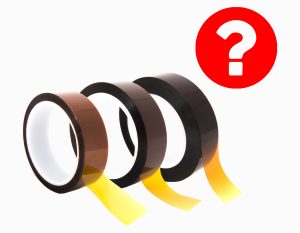
How Asking the Right Questions Can Help Manufacturers Select the Best Polyimide Tape for Many Applications
Polyimide tape is widely used across electronics manufacturing, aerospace, semiconductor production, EV battery assembly, and industrial processing because of its excellent heat resistance, electrical insulation properties, and durability. From PCB masking and wave soldering to insulation and component protection, selecting the right polyimide tape can directly impact product quality, process reliability, and operational efficiency.
However, not all polyimide tapes are the same. Choosing the wrong tape can lead to adhesive residue, lifting during high-temperature processes, insufficient insulation, or even damage to sensitive components. Before purchasing polyimide tape, manufacturers should evaluate several key factors to ensure the tape matches their application requirements.
Here are five important questions to ask before buying polyimide tape.
1. What Adhesive Type Does the Application Require?
One of the most important considerations when selecting polyimide tape is the adhesive system. Polyimide tapes are commonly available with either silicone or acrylic adhesive, and each offers distinct advantages depending on the application.
Silicone Adhesive
Silicone adhesive polyimide tape is designed for high-temperature environments and clean removal applications. It performs well in processes such as:
• Wave soldering
• Reflow soldering
• Powder coating
• High-temperature masking
Silicone adhesive removes cleanly with minimal residue, making it ideal for electronics manufacturing and rework-sensitive applications.
Acrylic Adhesive
Acrylic adhesive polyimide tape provides:
• Strong adhesion
• Good chemical resistance
• Long-term bonding performance
It is commonly used for general insulation, component holding, and applications where durability and secure adhesion are priorities.
Choosing the correct adhesive helps improve process reliability while reducing contamination and rework issues.
2. What Thickness Is Needed?
Polyimide tape is available in multiple thicknesses, and selecting the proper thickness can affect both performance and handling.
Thinner tapes offer:
• Greater flexibility
• Better conformability
• Easier application on uneven surfaces
Thicker tapes provide:
• Increased durability
• Improved puncture resistance
• Higher dielectric insulation properties
For precision masking and electronics assembly, thinner tapes are often preferred. For insulation and mechanical protection, thicker tapes may offer better long-term performance.
Understanding the specific environmental and mechanical demands of the application is critical when selecting tape thickness.
3. What Temperature Rating Is Required?
Polyimide tape is known for its ability to withstand elevated temperatures, but temperature ratings can vary depending on the adhesive system and construction.
Manufacturers should evaluate:
• Continuous operating temperature
• Short-term exposure temperature
• Process peak temperatures
Applications such as solder masking and electronics assembly may expose the tape to extreme temperatures for short periods, while industrial insulation applications may require long-term thermal stability.
Using a tape that is not rated for the required temperature range can result in:
• Adhesive failure
• Shrinkage
• Residue buildup
• Reduced insulation performance
Selecting the proper temperature-rated tape helps maintain process consistency and protects sensitive components during thermal cycling.
4. Does the Application Require Static Control?
In environments involving sensitive electronics, electrostatic discharge can damage components and disrupt production processes. For these applications, ESD Anti-Static Polyimide Tape may be necessary.
ESD-safe polyimide tape helps:
• Reduce static buildup
• Minimize electrostatic discharge risks
• Protect sensitive components
• Support ESD-controlled work environments
Industries that commonly require static-control tape include:
• Semiconductor manufacturing
• PCB assembly
• Aerospace electronics
• EV battery production
• Cleanroom operations
Standard polyimide tape may provide thermal and insulation benefits, but ESD-sensitive environments often require static-dissipative materials to maintain product reliability and process safety.
5. What Width and Length is Best for the Application?
Polyimide tape is available in a wide range of widths and roll lengths, and choosing the right size can improve efficiency while reducing material waste.
Narrow widths are commonly used for:
• Precision masking
• Circuit board work
• Fine-line applications
Wider rolls are often preferred for:
• Surface protection
• Large-area masking
• Insulation applications
Also, roll length can impact productivity. Longer rolls reduce changeover frequency during production, while shorter rolls may be more practical for maintenance or low-volume operations.
Selecting the correct dimensions helps streamline workflows and improve material utilization.
Final Takeaway
Polyimide tape plays an essential role in high-temperature manufacturing, electronics protection, insulation, and process masking. However, choosing the right tape requires more than simply selecting a standard product.
By evaluating adhesive type, thickness, temperature rating, static-control requirements, and tape dimensions, manufacturers can select a solution that improves reliability, reduces downtime, and supports consistent production performance.
Asking the right questions before purchasing polyimide tape helps ensure optimal performance in demanding industrial and electronics applications while protecting valuable equipment and sensitive components.
